


Passenger lists can tell us when our ancestors arrived, where they came from, and whom they left behind. But what did our ancestors remember about the villages they left? What languages did they speak? What was school like? How did families earn a living? And what did it actually feel like to leave Europe and arrive at Ellis Island?
The Ellis Island Oral History Project offers a fascinating way to explore those questions.
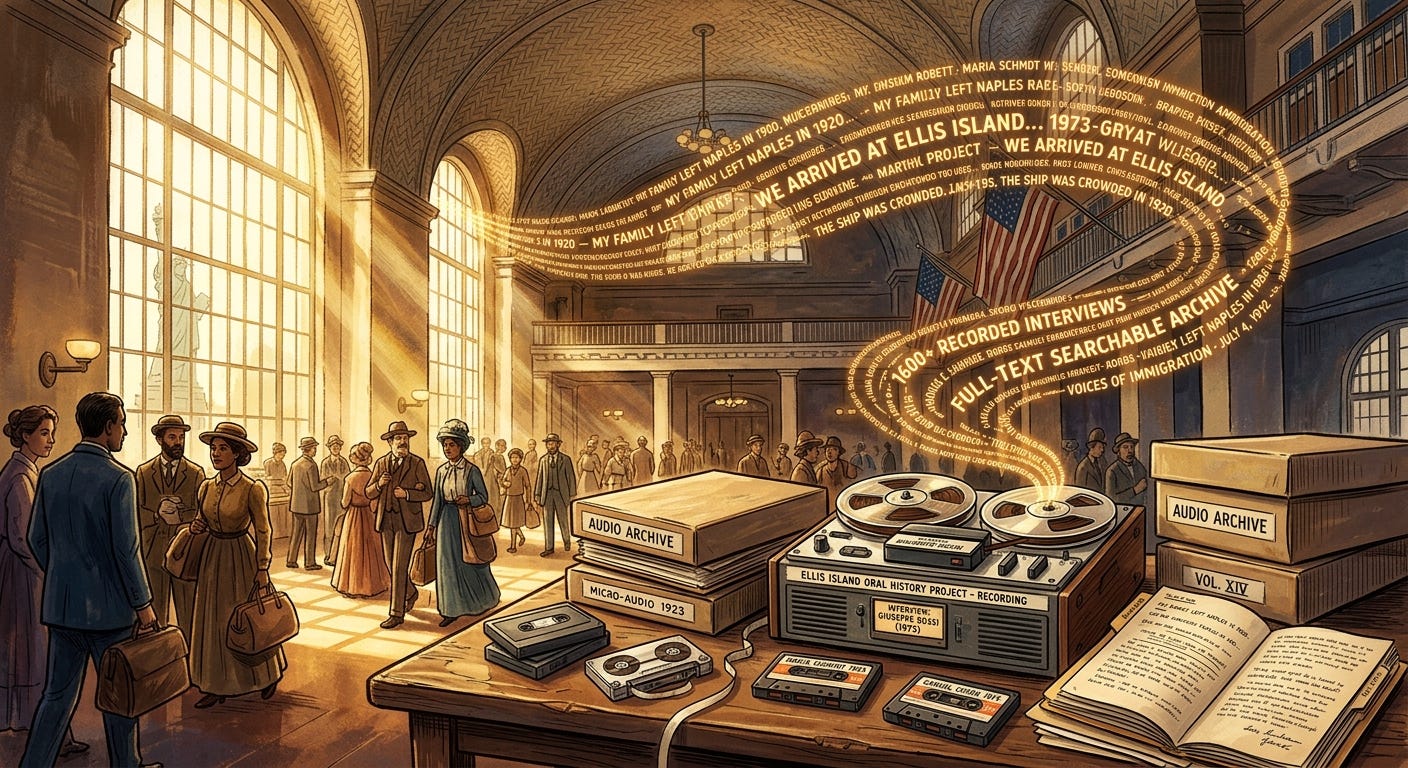
The collection contains over 1,600 interviews with immigrants, employees, military personnel, detainees, and others whose lives intersected with Ellis Island. The interviews are organized into five series covering interviews conducted from the 1970s through the 2000s. The largest is the Ellis Island (EI) series, with 1,213 interviews conducted primarily after the Ellis Island Immigration Museum opened in 1990. Many include audio recordings as well as searchable transcripts, allowing researchers to hear immigrants describe their experiences in their own words.
For genealogists, however, the site’s strongest feature may be its full-text search. You can search not only by name, country, and immigration year, but for words or phrases appearing anywhere in an interview. And for those researching Galicia, Poland, Ukraine, and former Austria-Hungary, the collection is particularly interesting, but you need to search creatively.
Galicia by Many Names
Historical geography in a modern setting presents an immediate challenge.
An immigrant from Galicia might describe a birthplace as Galicia, Austria, Austria-Hungary, Poland, or Ukraine, depending upon when the interview was conducted, how the interviewer phrased the question, and how the information was cataloged.
That means searching only for “Galicia” could cause you to miss some of the collection’s most interesting interviews.
One excellent example is Anastasia Pula Datzenko, who arrived in the United States in 1911 at age fourteen. Her interview is cataloged as coming from “the Ukraine (Austria-Hungary).” Yet when describing correspondence from her homeland, Datzenko recalled that they wrote “Austria Galicia” as part of the address. She also explained that although the territory belonged to Austria, her family was Ukrainian.
In just a few sentences, her recollections illustrate something Galician genealogists encounter repeatedly: Political jurisdiction, geographical identity, and ethnicity are not necessarily the same thing.
Anastasia’s interview goes much further. She discusses her Ukrainian Greek Catholic community, language, schooling, village library, farming, her father’s occupations, relationships among Ukrainians, Poles, and Jews, market activity, and the effects of World War I.
These are details we are unlikely to discover from a passenger manifest.
Reconstructing a Galician Community
Another intriguing interview is that of Dora Heller Rich, who immigrated in 1909 at age thirteen. She remembered Bilcze Złote, a community in Galicia, and described the population, Jewish families, synagogue and church, farming, orchards, livestock, schooling, and relations among people in the community.
Dora even remembered details of the physical environment: wooden houses, agricultural buildings, animals, apple and plum trees, and everyday village life.
What if the person being interviewed isn’t your ancestor?
That doesn’t make these interviews irrelevant. The interviews are precisely the type of evidence that can help a researcher reconstruct the environment in which an ancestor lived, even when the interviewee is unrelated to the researcher’s family.
Someone from your ancestor’s village—or even a nearby community—might describe the same church, synagogue, market town, agricultural practices, schools, occupations, transportation routes, languages, or migration patterns your ancestor experienced.
This is where oral history becomes especially powerful.
Don’t Stop with “Galicia”
The collection also contains numerous interviews cataloged under Austria, Austria-Hungary, Poland, and Ukraine. This is especially important when searching for immigrants who arrived before the collapse of Austria-Hungary in 1918. Someone cataloged as coming from “Poland,” for example, might have been born in Austrian Galicia before 1918. Likewise, a person identified with Ukraine might have been born when their village belonged to Austria-Hungary, interwar Poland, or the Russian Empire.
Rather than treating this as another name database, I would approach it as a historical context database. Treat the country listed in the catalog as a clue—not necessarily a definitive statement of historical jurisdiction. A productive search sequence would be:
Ancestral village: search every historical spelling and nearby market town.
District/county: search administrative and judicial centers.
Historical jurisdiction: Galicia, Galizien, Austria, Austria-Hungary, Poland.
Ethnicity/language: Ruthenian, Ukrainian, Polish, Jewish, German, Rusyn.
Religion: Greek Catholic, Roman Catholic, Jewish, synagogue, Orthodox.
Regional cities: Lemberg/Lwów/Lviv, Tarnopol/Ternopil, Stanisławów/Ivano-Frankivsk, Przemyśl, Tarnów, Kraków, as well as the names of your ancestral villages and nearby administrative centers.
Search for Experiences, Not Just People
Perhaps the greatest genealogical value of the Ellis Island Oral History Collection is that it encourages us to change the question we ask.
Instead of: “Is my ancestor in this collection?”
Consider these questions:
“Is someone from my ancestor’s community in this collection?”
“Is there someone whose experience can help me understand my ancestor’s life?”
A Galician farmer who arrived in 1907 may never have been interviewed. But another immigrant from the same district might describe farming practices, religious observances, schooling, village markets, ethnic relationships, the journey to a European port, steerage conditions, or the experience of being inspected at Ellis Island.
Experiment with search terms connected with identity and everyday life: Ruthenian, Ukrainian, Polish, Jewish, German, Greek Catholic, Roman Catholic, synagogue, farm, village, school, market, military, World War I, and other words relevant to your research.
Those memories can provide the social and historical context needed to transform names, dates, and places into a family story.
Add Oral History to Your Research Toolbox
The Ellis Island Oral History Collection doesn’t replace passenger manifests, metrical records, archival research, gazetteers, or historical maps. It complements them.
Once you have identified your ancestral locality, spend some time searching the oral histories for that village, nearby towns, historical jurisdictions, ethnic groups, religions, and experiences associated with your family.
You may not hear your ancestor’s voice. But you just might hear the voice of someone who walked the same village roads, attended a neighboring church or synagogue, shopped at the same market, crossed the same borders, and made the same journey toward America.
And that can bring us remarkably close to understanding the world our Galician ancestors left behind.
A special Thank You to Matthew Housch, NPS Curator of Collections and Archives of Ellis Island, for making this resource available to the public!
Michelle, this is an outstanding resource with some great pointers. I think my podcasts will take a back seat to these recordings. Thank you!